
Why Choosing the Right Japanese Knife Matters
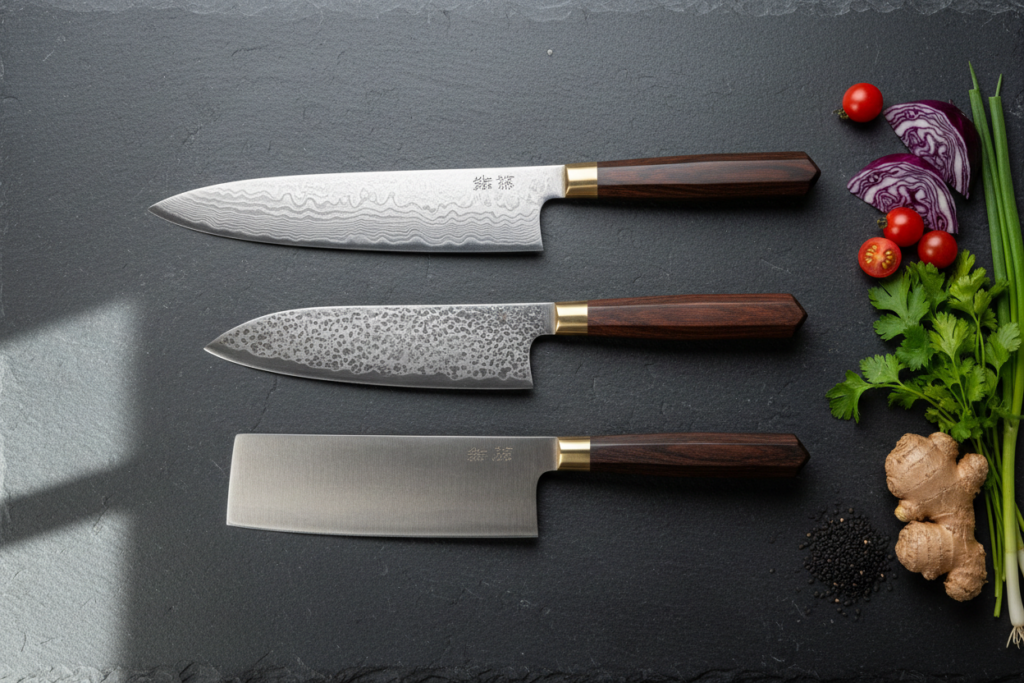
Walk into any serious cook’s kitchen and you’ll find at least one Japanese-style knife. But with so many styles available – Gyuto, Santoku, Nakiri – how do you know which one to buy first?
The good news: you don’t need all three. Most home cooks only need one or two knives to handle 90% of their kitchen tasks. This guide will help you understand the differences between these three popular Japanese knife styles and choose the right one for your cooking style.
At Iron Hammer, we hand-forge all three styles using premium carbon steel and traditional Vietnamese blacksmithing techniques. We’ve helped thousands of home cooks and professional chefs find their perfect knife – and we’re here to help you do the same.
What is a Gyuto Knife?
The Gyuto (牛刀) is the Japanese equivalent of the Western chef’s knife – but better. The name literally means “cow sword,” reflecting its original design for butchering beef. Today, it’s the most versatile Japanese knife you can own.
Gyuto Key Features:
- Blade Length: 210mm (most popular) or 240mm for larger tasks
- Blade Shape: Curved belly with a pointed tip – perfect for both rocking and push cuts
- Weight: Lighter than a Western chef’s knife, better balanced
- Best For: Meat, fish, poultry, vegetables – truly all-purpose
What Can You Cut with a Gyuto?
The Gyuto excels at virtually everything:
- Slicing boneless meat and fish
- Breaking down whole chickens
- Dicing and mincing vegetables
- Thin-slicing for sushi and sashimi prep
- Chopping herbs and aromatics
- Precision work with the pointed tip
The Iron Hammer Gyuto 210mm is hand-forged from 52100 carbon steel – a steel prized by professional bladesmiths for its exceptional edge retention and toughness. Paired with a beautiful walnut handle, it’s the perfect all-purpose knife for any kitchen.
What is a Santoku Knife?
The Santoku (三徳) means “three virtues” in Japanese – referring to its ability to handle meat, fish, and vegetables. It’s shorter and lighter than a Gyuto, making it a favorite among home cooks who prefer a more compact knife.
Santoku Key Features:
- Blade Length: 180mm standard
- Blade Shape: Flatter belly with a sheep’s foot tip (no sharp point)
- Weight: Lighter than Gyuto, very nimble
- Best For: Vegetables, fish, boneless meat – excellent for push cuts
What Can You Cut with a Santoku?
- Slicing vegetables with precision
- Dicing onions, carrots, and root vegetables
- Filleting fish and slicing boneless meat
- Mincing garlic and herbs
- Thin-slicing for Asian cooking
The Iron Hammer Santoku 180mm is available in both stainless steel and 52100 carbon steel versions. The compact size makes it ideal for smaller hands or cooks who prefer a lighter knife.
What is a Nakiri Knife?
The Nakiri (菜切り) means “vegetable cutter” – and that’s exactly what it’s designed for. With its flat, rectangular blade and blunt tip, the Nakiri is the ultimate vegetable knife.
Nakiri Key Features:
- Blade Length: 180mm standard
- Blade Shape: Flat, rectangular blade – no curve, no tip
- Weight: Light and nimble
- Best For: Vegetables exclusively – push-cut technique
What Can You Cut with a Nakiri?
- Julienne and brunoise cuts with precision
- Thin-slicing cucumbers, zucchini, and daikon
- Chopping leafy greens and herbs
- Meal prep for large quantities of vegetables
- Asian cooking: stir-fry prep, sushi vegetables
The Iron Hammer Nakiri Sanmai 180mm features an Aogami #2 (Blue Steel) core with Sanmai construction – giving you the sharpest possible edge for precision vegetable work.
Gyuto vs Santoku: Head-to-Head Comparison
| Feature | Gyuto | Santoku |
|---|---|---|
| Blade Length | 210-240mm | 180mm |
| Blade Shape | Curved belly, pointed tip | Flat belly, sheep’s foot tip |
| Best Cutting Style | Rocking + push cuts | Push cuts |
| Best For | Meat, fish, vegetables | Vegetables, fish, boneless meat |
| Skill Level | Beginner to advanced | Beginner friendly |
| Versatility | ⭐⭐⭐⭐⭐ | ⭐⭐⭐⭐ |
Verdict: The Gyuto wins on versatility. If you cook a variety of proteins and vegetables, the Gyuto is the better all-purpose choice. The Santoku is better if you prefer a shorter, lighter knife and cook mostly vegetables and fish.
Santoku vs Nakiri: Head-to-Head Comparison
| Feature | Santoku | Nakiri |
|---|---|---|
| Blade Shape | Slight curve, sheep’s foot | Flat, rectangular |
| Best For | Vegetables + fish + meat | Vegetables only |
| Cutting Style | Push cuts + some rocking | Push cuts only |
| Versatility | ⭐⭐⭐⭐ | ⭐⭐ (vegetables only) |
| Vegetable Precision | ⭐⭐⭐⭐ | ⭐⭐⭐⭐⭐ |
Verdict: The Santoku is more versatile, but the Nakiri is better for pure vegetable work. If you follow a plant-based diet or do a lot of meal prep, the Nakiri’s flat blade gives you cleaner, more precise cuts through vegetables.
Which Japanese Knife Should You Buy First?
Buy a Gyuto if:
- You cook a variety of proteins (meat, fish, poultry) and vegetables
- You want one knife that does everything
- You use rocking cuts as well as push cuts
- You’re a professional chef or serious home cook
- Recommended: Iron Hammer Gyuto 210mm (52100 Carbon Steel)
Buy a Santoku if:
- You prefer a shorter, lighter knife
- You cook mostly vegetables and fish
- You have smaller hands or prefer a compact knife
- You’re a beginner looking for an easy-to-use Japanese knife
- Recommended: Iron Hammer Santoku 180mm
Buy a Nakiri if:
- You cook mostly vegetables (plant-based, Asian cooking)
- You want the most precise vegetable knife possible
- You already have a Gyuto or Santoku and want to add a specialist
- You love the push-cut technique
- Recommended: Iron Hammer Nakiri Sanmai 180mm (Aogami Blue Steel)
FAQ: Gyuto vs Santoku vs Nakiri
Can I use a Gyuto for vegetables?
Absolutely. The Gyuto is excellent for vegetables – its pointed tip and curved belly give you more cutting options than a Santoku or Nakiri. It’s the most versatile of the three.
Is the Santoku good for beginners?
Yes – the Santoku is one of the most beginner-friendly Japanese knives. Its shorter length and lighter weight make it easy to control, and the sheep’s foot tip is safer for new knife users.
Do I need all three knives?
No. Most home cooks only need one or two knives. Start with a Gyuto (most versatile) or Santoku (beginner-friendly), then add a Nakiri if you find yourself doing a lot of vegetable prep.
What’s the best Japanese knife for a beginner?
The Santoku 180mm is the most beginner-friendly Japanese knife. It’s shorter, lighter, and easier to control than a Gyuto. The Iron Hammer Santoku is a great starting point for anyone new to Japanese knives.
Why Choose Iron Hammer Handmade Knives?
At Iron Hammer, every knife is hand-forged by Vietnamese artisan blacksmiths using traditional techniques and premium carbon steel. Our knives combine:
- Vietnamese Craftsmanship – Centuries-old blacksmithing traditions
- Japanese Precision – Knife-making techniques refined over generations
- Premium Steel – 52100 carbon steel and Aogami Blue Steel
- Exceptional Value – Handmade quality at accessible prices
Ready to find your perfect knife? Shop the Iron Hammer knife collection and discover the difference that authentic handmade craftsmanship makes.